
Trace Holmes County Former Owners by Transfer
Start with the newest deed matching the Holmes County parcel. Treat every earlier transfer as its own row. One row per transfer. The model keeps former owners, instrument type, date, and land reference together. That way a same-name person or a nearby tract never folds into the wrong history, and the table stays a record-keeping aid rather than a sample of a real parcel.
| Transfer Date | Grantor to Grantee | Deed Type | Book/Page or Instrument |
|---|---|---|---|
| Newest verified transfer | Prior holder to current grantee | As indexed | Copy the exact reference |
| Next earlier transfer | Earlier holder to prior grantee | As indexed | Match the legal description |
| Earlier book-era transfer | Earlier parties as written | As recorded | Preserve volume and page |
The current deed names the first grantor. Search that person next as a grantee. A quitclaim conveys only the interest a signer held, while a warranty deed carries different promises, so neither label alone proves the whole chain. Confirm the legal description at each step.
Reverse Index Traces Holmes County Former Owners
The Holmes County Chancery Clerk maintains direct, reverse, subdivision, and sectional land indexes. The office publishes no online deed index. Tracing previous owners is therefore an office-led property search. Call 662-834-2508 with the current grantee, an approximate transfer date, and the legal description. The reverse index is the natural first stop. It locates a deed by the buyer's name. The deed then reveals the seller, who becomes the next grantee to chase deeper into the Holmes County deed records.
The clerk's land-record instructions list inspection hours from 8 a.m. to 5 p.m. Monday through Friday. Received documents generally become public the next day. Staff can make copies or answer a reasonably specific mailed request. Confirm current procedures before sending payment or personal documents.
Note: Bring dates and a legal description, since a street address alone may not connect an old deed to the correct Holmes County tract.
Reach Holmes County Former-Owner Records Four Ways
Four channels reach these records. Options span the courthouse counter, the telephone, mail, and a written public-record request. At the counter, inspect the direct or reverse index and pull the cited book. A call first saves trips. A mail request should name the parties and an approximate date. It should also give the instrument type and the book and page when known. If the routine path fails, the Mississippi Public Records Act provides a written-request route. That route works for a reasonably specific record.
| Channel | Best Detail to Supply | Useful Result |
|---|---|---|
| Courthouse inspection | Current grantee and legal description | Index and volume references |
| Phone, 662-834-2508 | Names and approximate dates | Procedure and availability check |
| Specific mailed request | Book/page or a narrow search | Plain or certified copy options |
| Records Act request | Identifiable records and date range | Written response, fees, or exemption basis |
MDAH Extends Holmes County Former-Owner History
Older volumes call for a different kind of search. When a chain reaches back that far, the Mississippi Department of Archives and History county-records catalog is the next finding aid. Its Holmes entries include microfilmed abstract books and overlapping roll descriptions. Some entries lack an index. Confirm the exact roll and volume before travel. MDAH notes that its Media Room offers self-service access to county microfilm. Those rolls were copied by the agency, private vendors, and the Genealogical Society of Utah.
The catalog page itself illustrates the point. Archive research begins with a collection description. It never begins with an assumed online cutoff for Holmes County deed records.
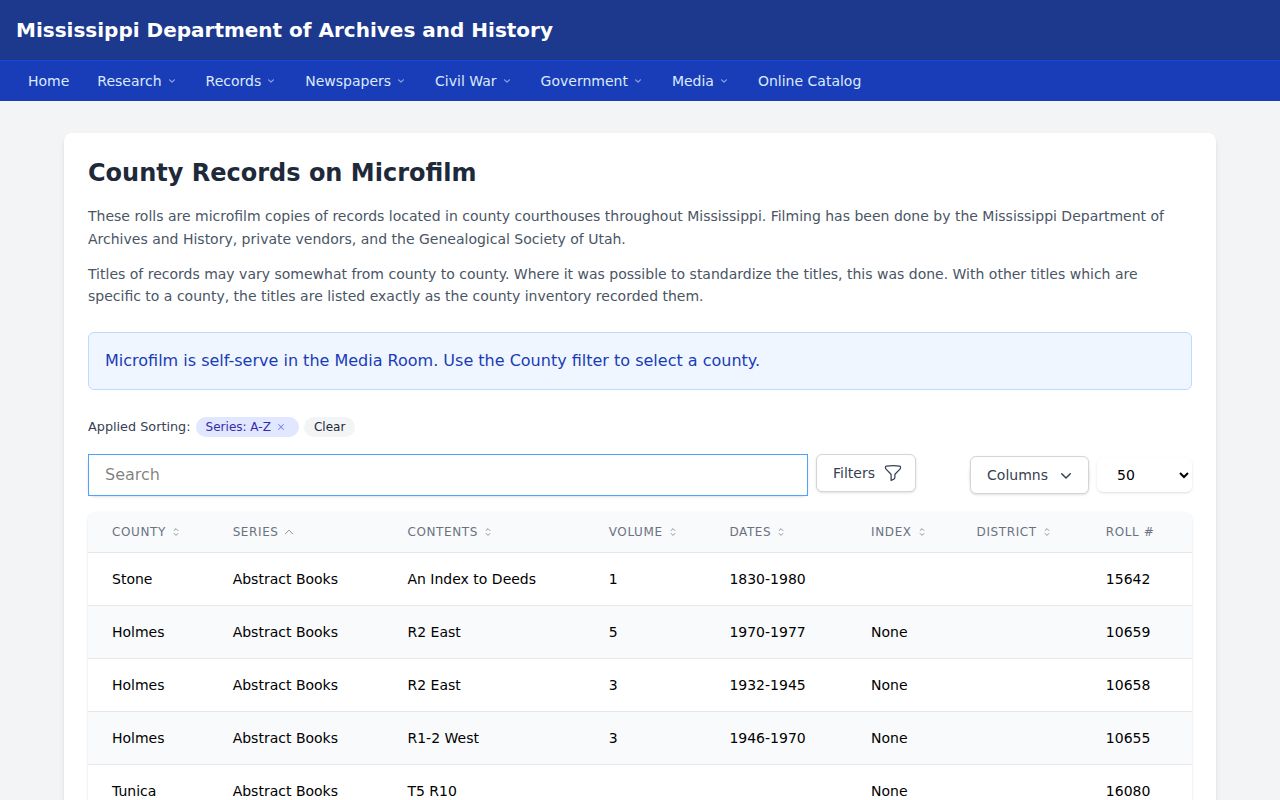
The listed rolls point toward historic material. Each relevant name and deed reference still needs tying back to the Holmes County legal description.
Holmes County Former Owners Reach Toward 1833
Holmes County was organized in 1833. Depth is possible here. The MDAH original-records finding aid lists land applications and deeds from the 1830s through the 1850s, tax-collector sale material from 1849, early assessor records, and a transcribed will book covering 1833 through 1888. Those holdings support a deep property search. They do not prove that every original courthouse volume survives or that every transfer was indexed the same way.
No authoritative courthouse-fire or flood loss appears in the official accounts. Test any gap instead of blaming an invented disaster. Alternate index spellings, probate files, tax-sale material, and adjoining deeds often fill it. County formation matters near Tchula. A pre-1833 reference may route to predecessor Yazoo County records before it joins the Holmes chain.
Walk Holmes County Prior Owners in Reverse
Keep the land constant while the names change. The current assessor roll may suggest a starting owner, but the newest recorded deed is stronger evidence of a transfer. Work in reverse.
- Ask for the latest instrument in which the current owner appears as grantee, then record its date, type, book/page, and full legal description.
- Read the grantor exactly as written, including initials, spouse, trustee, executor, or other legal capacity.
- Search that grantor as an earlier grantee in the reverse index, then compare acreage, lot/block, or section-township-range language.
- Repeat until the index route ends, then continue with the cited deed books, MDAH microfilm, probate, tax-sale, or plat material.
- Grantor and grantee
- The party conveying an interest and the party receiving it.
- Chain of title
- The linked sequence of instruments affecting the same land.
- Reverse index
- An index organized by grantee, useful for finding how an owner acquired the property.
- Warranty and quitclaim deeds
- Different conveyance forms whose names do not, by themselves, establish a complete title history.
Probate Can Explain Missing Holmes County Prior Owners
A neat sale-to-sale chain can break. Land often passed through an estate. It also passed through an heirship, a partition, a life estate, or a trust. The Chancery Clerk also keeps probate files. Search the deceased owner's estate. Do this when no ordinary deed explains the next name in the Holmes County property records. Record the signer's role. Executor, administrator, trustee, or heir each lead to different paperwork. The property description, not a surname match, should tie the transfer to the right parcel.
Assessment rolls help, but they are not conveyances. Mississippi assesses property to the owner of record on January 1. A later transfer can leave two names on one tax bill. Use the roll to narrow the window. Then document the transfer with the deed or the probate instrument itself.
Historic Rolls Bridge Holmes County Former-Owner Gaps
The digitized Holmes assessment-roll series at MDAH reaches from 1833 into 1873. Streets had no numbers back then. What the rolls offer instead is a way to pin a taxpayer to a district or a described tract. That placement holds between one deed event and the next. Treat each entry as dated assessment evidence, nothing more. A name on a roll does not prove good title to the land.
That preserved image gives former-owner research a second chronology to set beside the deed books. Assessment years and deed years rarely line up neatly. The gap between them is where the rolls earn their keep in Holmes County property records work.
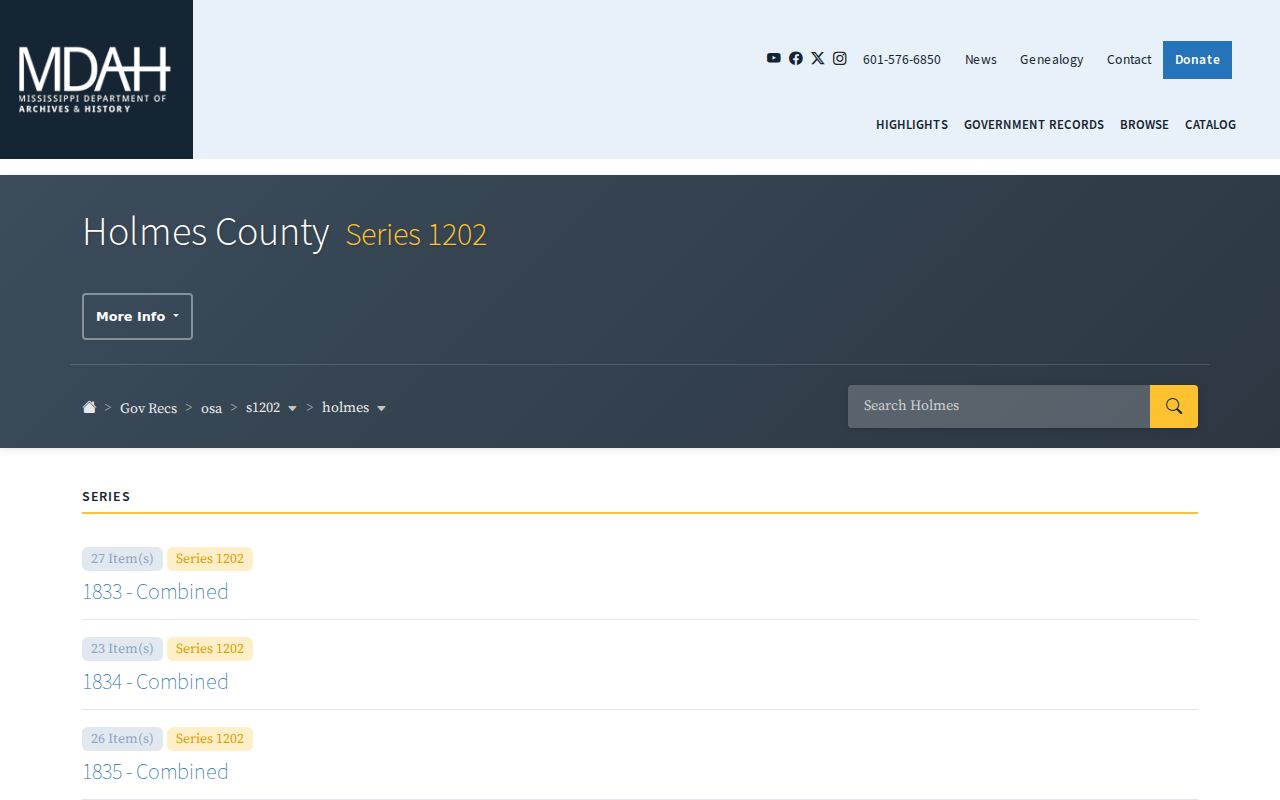
Match the roll's year and spelling against the reverse deed index first. Then ask whether an estate or a tax sale explains the change in ownership. The free Holmes County newspaper archive holds 20,619 pages spanning 1843 through 1924. The Holmes County Farmer and related titles sit inside it. Estate notices, sheriff and tax-sale notices, ads, and road or plantation names can point to the right person. That helps when several share a surname. A newspaper fact stays a lead, though. Wait for a recorded instrument, probate order, or assessment entry to confirm it in the Holmes County property records.
Legal Descriptions Keep Holmes County Past Owners Together
Holmes County addresses come in three flavors: situs, mailing, and legal description. They are not interchangeable. A rural owner may get mail at a post office box in another town. An early deed might name only section, township, range, acreage, a road, or the adjoining owners. No house number appears anywhere. Inside a platted town, the stable key differs. It is more often the subdivision, lot, block, easement, or right-of-way.
Log every variant as you go. Keep initials, former surnames, road spellings, adjoining-owner names, and acreage changes intact. One plat can expose a lot split or replat. Suddenly a single apparent chain becomes two. MARIS parcel geometry adds current map context. Yet it cannot replace the recorded plat, the deed description, or a survey of the parcel.
Note: One mailing address can serve several parcels. A single Holmes County tract may lack any dependable historic street address at all.
Measure Holmes County Former-Owner Record Depth
Holmes County publishes no online deed index. So there is no supported cutoff year for an online chain of title. Avoid claiming the web trail begins in any particular year. The sound path runs through the Chancery counter. Its mail channel also serves local indexes and volumes. From there, MDAH's catalog, microfilm, early original-record finding aids, and digitized assessment material carry the work further back. Archival descriptions reach nearly to the county's 1833 formation. A specific parcel may still stop earlier. Its description may have changed. Or its predecessor record may sit in another office entirely, which is common when tracing deed records this deep.
No invented cutoff. Holmes County has no verified public deed-index start year. Older former owners must be traced through courthouse indexes, deed books, microfilm, and related archives.
A reconstructed history is not a title opinion. It serves well for house history and estate work. It also helps with boundary due diligence, or with shaping a focused records request to the recorder or assessor. But a true ownership dispute needs professional title or legal help. So does an unrecorded interest or a broken legal description. That line is worth remembering before you lean on any chain of Holmes County property records.