
Compare Holmes County Property Value Types
Label every number before you line it up next to another. Mississippi starts with true or market value. It applies a statutory class ratio to reach assessed value. It then applies millage to calculate the tax. A sale consideration sits in a different record entirely. Treat it as one transaction. Never treat it as the assessor's current opinion of what a Holmes County property is worth.
| Value Type | What It Means | Where It Is Recorded |
|---|---|---|
| True or market value | The assessor's estimate of full value under state appraisal rules | Holmes County assessment roll or parcel printout |
| Assessed value | True value multiplied by the property's Mississippi class ratio | Assessment roll |
| Land and improvement values | Separate components supporting the total valuation | Fields to request from the assessor |
| Last sale or consideration | A transaction amount when shown, not a present appraisal | Recorded deed, tax stamp, or local field if available |
Holmes County publishes no public parcel card showing those exact fields. Request land, improvement, total true or market, assessed, class, exemption, tax year, and any transfer reference directly from the office.
Mississippi Ratios Shape Holmes County Assessed Value
The Mississippi Department of Revenue sets out five assessment classes. Class I covers single-family owner-occupied residential property at 10 percent of true value. Classes II and III generally sit at 15 percent. Class II is real property outside Class I. Class III is personal property. Class IV public-service property carries 30 percent. Class V motor vehicles also carry 30 percent. Confirm the class on the Holmes record before running any math on it.
| Recorded Figure | Role in the Calculation | Question to Ask |
|---|---|---|
| True or market value | Starting estimate before the class ratio | Which tax year and components? |
| Assessment class | Determines the applicable ratio | Why was this parcel placed in that class? |
| Assessed value | True value multiplied by the ratio | Does the printed math match? |
| Taxable amount | May reflect exemptions or other adjustments | Which adjustment created the difference? |
Those figures explain what a valuation means. Billing, delinquency, and appeals live in the tax-record process instead.
Ask Holmes County for Property Value Fields
The Holmes County Assessor/Collector locates, classifies, and assesses taxable property each year, maintains the ownership maps, and presents the rolls to the Board of Supervisors. The office sits at 1 Court Square in Lexington, reachable at 662-834-2865, with mail to PO Box 449, Lexington, MS 39095. The county hosts no parcel-card search or public results screen.
Give the office something precise to work with. Include the situs address, any parcel number or map reference, a legal description clue, and the tax year. Ask staff to separate the individual fields rather than simply handing over one value. For an uncertain rural situs, the E-911 Addressing Office at 662-235-5126 can confirm the assigned address from the nearest street and neighboring properties.
Note: Holmes County publishes no online parcel-card fields, so a precise office request beats assuming another county's portal layout.
Look Up a Holmes County Property Value by Record
An address makes a good entry point. Keep the parcel and tax year constant while you compare figures. With no online assessor search available, the office request is the core step, not a backup.
- Confirm the situs address or parcel clue with the assessor, ownership map, or E-911 for a rural tract.
- Request the assessment printout for a named tax year, including land, improvements, total true or market value, class, assessed value, and exemption fields.
- Check the arithmetic by applying the verified class ratio to true value, and ask the office about any difference instead of guessing.
- If a transaction comparison matters, ask the Chancery Clerk for the recorded deed and whether consideration or a tax stamp appears.
- True or market value
- The assessor's estimate before application of the statutory assessment ratio.
- Assessed value
- The amount produced by applying the property's class ratio to true value.
- Assessment ratio
- The percentage assigned by Mississippi law to a property class.
- Sale consideration
- A transaction amount that may appear in a deed or transfer record and may not equal current market value.
- Reassessment
- A new valuation process; Mississippi requires real property to be revalued at least once every four years.
Jan. 1 Dates Holmes County Assessed Value
Mississippi assesses property to the owner of record on January 1. That single date explains many mismatches. A deed recorded later in the year can name a new owner. The assessment roll still shows the earlier one. Holmes County publishes no refresh schedule or closing-to-roll lag. Compare by tax year rather than by recording date.
State law requires real property to be revalued at least once every four years. Treat that as a ceiling. It is not a promise that every Holmes parcel changes on one date. Keep the land, improvement, total, class, and exemption fields from each printout. A change can then be explained rather than just noticed.
Sale Price Is Separate From Holmes County Property Value
The Chancery Clerk holds the deeds along with the direct, reverse, subdivision, and sectional indexes. The county exposes no online deed result showing a sale-price field, so ask whether the recorded deed, its consideration clause, or transfer-tax information states an amount. Copy the instrument date and book/page alongside it.
A sale amount reflects circumstances an assessment never captures. The interest conveyed, related-party terms, multiple parcels, or noncash consideration can all shape it. It stands as one historical transaction, not a current appraisal. Confirm the deed and the assessment describe the same land before comparing the two.
Tax-Forfeited Holmes County Property Values Need Context
The Mississippi tax-forfeited property application can show county, parcel number, property address, assessed owners, legal description, section, township, range, subdivision, and last reported market value. That statewide inventory tracks tax-forfeited property only. It serves a different purpose from the Holmes County assessment roll.
The system itself warns that its market value is general information. The actual price is set through the official application or offer process. Never treat the figure as a live asking price, an appraisal, or a comparable. Verify the parcel, date, and status through the state system first.
Historic Holmes County Assessed Values Show Change
The MDAH digitized assessment-roll series includes Holmes County items from 1833 through 1873. Those rolls record assessed names and values from an earlier tax era. This was long before parcel cards or street addresses existed. They anchor a chronology well. But an old assessed figure should never be converted into a present market estimate. The digitized image ties historical value research to a dated roll. It does not reflect a modern listing.
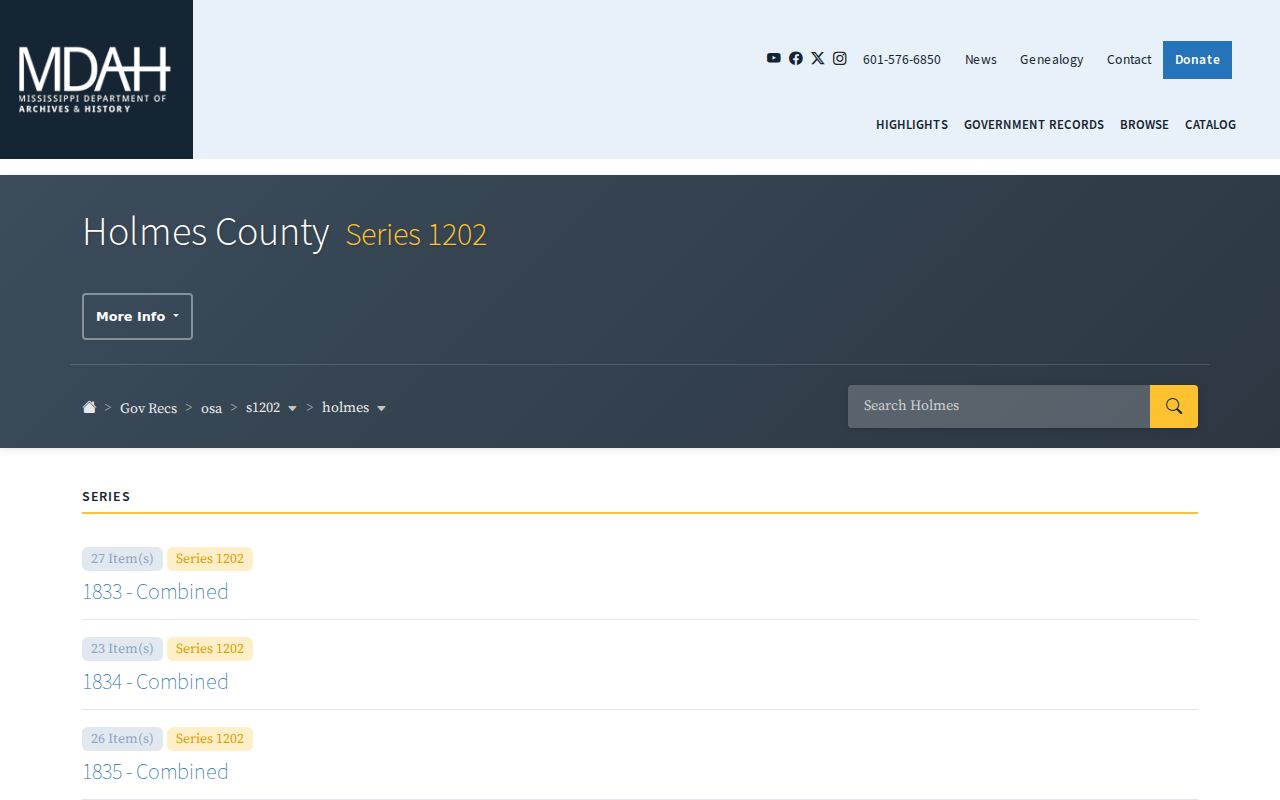
Match the taxpayer, district, or land description to deeds and later rolls first. Only then treat two entries as the same Holmes County parcel.
Historic Status Does Not Set Holmes County Property Value
Lexington's Historic Resources Inventory lists named buildings with stable HRI identifiers. It gives street addresses along Courthouse Square, Vine, Tchula, Telegraph, Wall, and Yazoo streets. That layer is rich context. It helps with structure history and block-level background. It proves no tax exemption, though. It sets no assessment class or owner of record.
Durant's depot and state park historic districts, along with Tchula's lake and Main Street history, work the same way. They give context without a city value trend. None of these towns publishes a city-level revaluation report or a last-sale series. For comparisons, rely on year-labeled Holmes County assessment printouts rather than assumptions about appreciation.
Know What Holmes County Property Value Cannot Prove
An assessment comes from mass appraisal built for taxation. It does not inspect every feature the way a private appraisal would. It may also lag a recent sale or a later property change.
A deed consideration is not an appraisal either. It simply records a transaction term when one is stated, and the tax-forfeited inventory's last reported market value carries its own state warning.
Value is not price. Holmes County assessed value supports taxation. It is not a promise of sale price, a boundary finding, or a licensed appraisal.
Compare parcels using consistent years and definitions. Before a purchase or sale decision, pair the public record with current condition evidence. Add a qualified valuation before you commit. Questions about the tax bill, exemptions, delinquency, or an appeal belong with the dedicated Holmes County property tax records guidance. That resource tracks the assessor and tax roll details this page does not.