
What Holmes County Property Tax Records Contain
The Tax Assessor/Collector keeps the annual assessment roll. The office also maintains current ownership maps. Real, personal, manufactured-home, and vehicle taxes all flow through the same counter. A tax inquiry works best when you separate the assessed parcel facts from the account balance, since one side explains valuation and the other shows billing, payment, and delinquency.
| Field | What it shows | Where to ask |
|---|---|---|
| Owner and parcel | Owner of record, situs, mailing address, parcel identifier, legal description | Tax Assessor |
| Value | Land, improvements, true or market value, assessed value, class | Tax Assessor |
| Relief | Homestead or other exemption status | Tax Assessor |
| Bill | Tax year, amount due, payment, and delinquency | Tax Collector |
| Sale status | Annual county sale or later state forfeiture | Collector, Chancery Clerk, or Secretary of State |
Linda Rollins serves as Tax Assessor/Collector, with the office at 1 Court Square, PO Box 449, Lexington, MS 39095, reachable at 662-834-2865. The official Assessor/Collector page describes both sides of the office.
Look Up a Holmes County Tax Bill by Parcel
Holmes County publishes no public tax-bill search screen. The county does link an online payment service. Treat that payment page as a convenience rather than a complete tax-record index, and confirm any amount, year, or parcel match with the office.
- Collect the situs address, owner name, and parcel number from a bill or assessor printout.
- Call the Assessor at 662-834-2865 to confirm that all three refer to the same land.
- Ask the Tax Collector for the billed amount, payment state, and delinquency for the tax year needed.
- If the tax is delinquent, ask whether it remains local, went through the annual sale, or entered the state inventory.
- Confirm the accepted payment method before sending funds.
- True or market value
- The assessor's estimate before the class ratio is applied.
- Assessed value
- The taxable value produced by applying the statutory class ratio.
- Millage
- The levy applied to assessed value to calculate tax.
- Tax lien
- A claim arising from unpaid tax, not proof that the state already owns the parcel.
Note: A receipt settles a tax question, but it clears no deed, lien, or boundary issue attached to the parcel.
How Mississippi Calculates Holmes County Property Tax
Mississippi runs a two-stage calculation, as the Mississippi Department of Revenue explains. First the assessor estimates true, or market, value. That value is multiplied by the ratio for the property's class. Taxing authorities then apply millage to the assessed figure. Class I owner-occupied single-family homes are assessed at 10 percent. Class II, covering rental, commercial, and second-home property, sits at 15 percent. Public utility property makes up Class III at 15 percent. Personal property is Class IV, also at 15 percent. Motor vehicles fall into Class V at 30 percent.
Class matters as much as the market estimate. Two parcels can share similar true values. Their assessed values can still land far apart when their legal classes differ. Ask separately for class, true value, assessed value, and millage rather than just "the value."
The January 1 Holmes County Assessment Snapshot
Mississippi taxes the January 1 owner of record. Because the roll is an annual snapshot, a deed recorded later may name a buyer. Meanwhile the current tax roll may still list the seller. Holmes County publishes no fixed closing-to-roll refresh interval. So date both records before deciding one is wrong. The revaluation clock and the deed clock run separately. Real property must be revalued at intervals of no more than four years. Adjustments can occur between cycles when warranted. That schedule does not move every parcel at once. Building changes, classification shifts, land characteristics, and corrected parcel facts can each affect an individual record.
Read the dates. The January 1 roll identifies the assessed owner for that tax year; the latest recorded deed is the stronger transfer evidence.
Holmes County Homestead Filing Season
Homestead applications run January 1 through April 1 with the county assessor. The state homestead guidance spells out eligibility. It also lists what an applicant should bring, commonly the property description, purchase information, Social Security numbers for the applicant and spouse, vehicle tags, and income details when an additional exemption is claimed.
An accepted homestead flag is about tax relief. It does not prove that no deed problem exists. Nor is it conclusive evidence of who occupies the property now. Owners must report any change affecting eligibility. Holmes County posts no online application, so call the office for the local form and the current document checklist.
Contest a Holmes County Assessment on Time
The assessor presents the roll to the Board of Supervisors each year, and Mississippi's review route ordinarily ends on the first Monday in August. Start well before that meeting. Ask early. Request the property record, class, land and improvement figures, comparable basis, and the local objection procedure.
- Check the parcel facts and classification for a simple factual error.
- Collect deeds, photographs, repair evidence, surveys, or credible comparable information relevant to value.
- Request the current Holmes County objection form and deadline.
- Present the objection to the Board route described by the assessor.
- Ask for a written result and the next appeal step if the issue remains.
Deadline matters. Contact the Holmes County Assessor before the August review date; a late value complaint may have to wait for another cycle.
Delinquency, the Annual Sale, and State Forfeiture
The Tax Collector holds one annual sale. It covers unpaid real-property and special-assessment taxes. County instructions route delinquent payments through the Chancery Clerk and list traditional payment methods, which should be confirmed before a visit. A sale record is not a conventional deed sale. It demands follow-up on redemption and later forfeiture.
The Secretary of State tax-forfeited search is a separate statewide database. Search fields include county, address, city, ZIP, subdivision, parcel number, PPIN, market-value range, assessed owner, legal description, section, township, and range. Results may show the parcel number, county, address, assessed owners, and market value. Saving a property or applying requires an account.
The state tax-forfeited parcel map shows the statewide entry point:
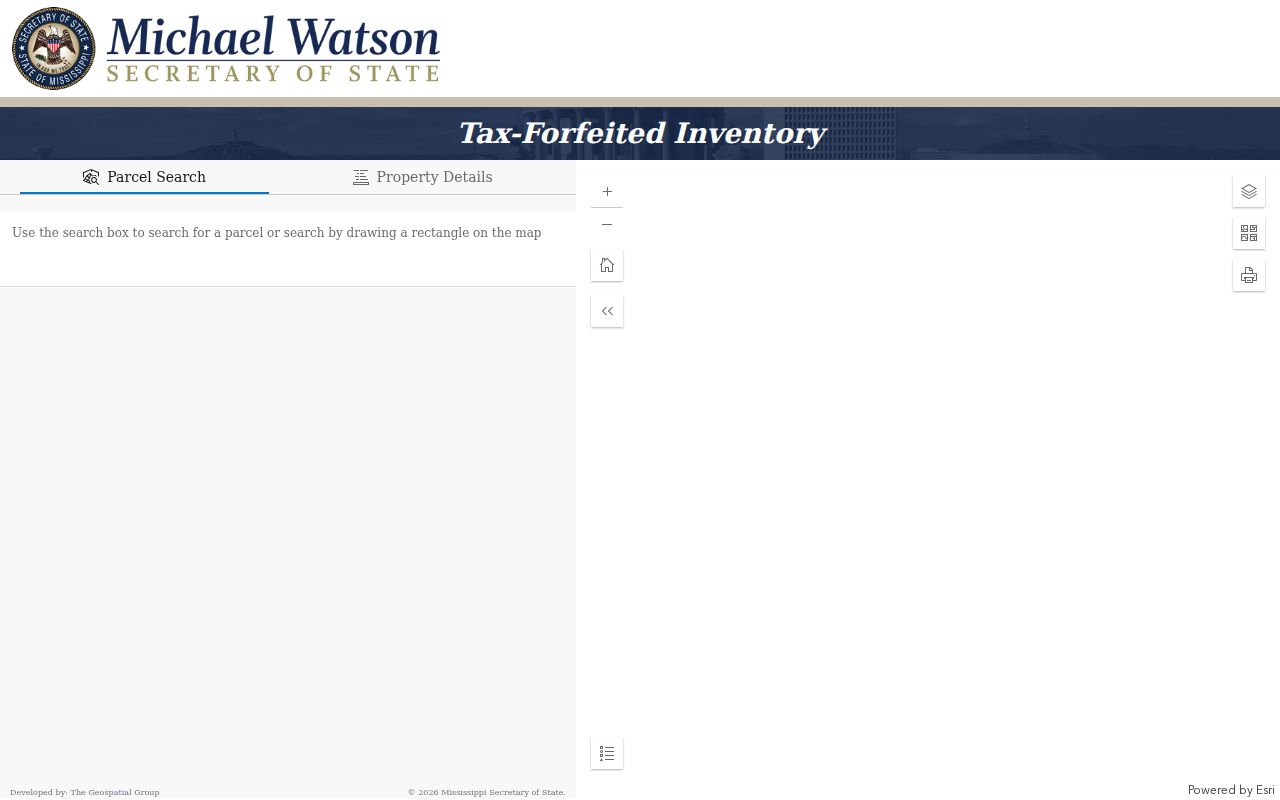
Check the county account, sale, redemption, and legal-description details first. The map's displayed market value is general information, not the eventual offer price.
Historic Holmes County Assessment Rolls
Historic tax research reaches past the current office. The Mississippi Department of Archives and History assessment-roll series holds digitized Holmes material from 1833 through 1873. A surname, district, land description, taxable property, and year can all line up there. These records predate modern street addresses. They predate parcel numbers too.
The MDAH series shows digitized images of those Holmes County assessment pages:
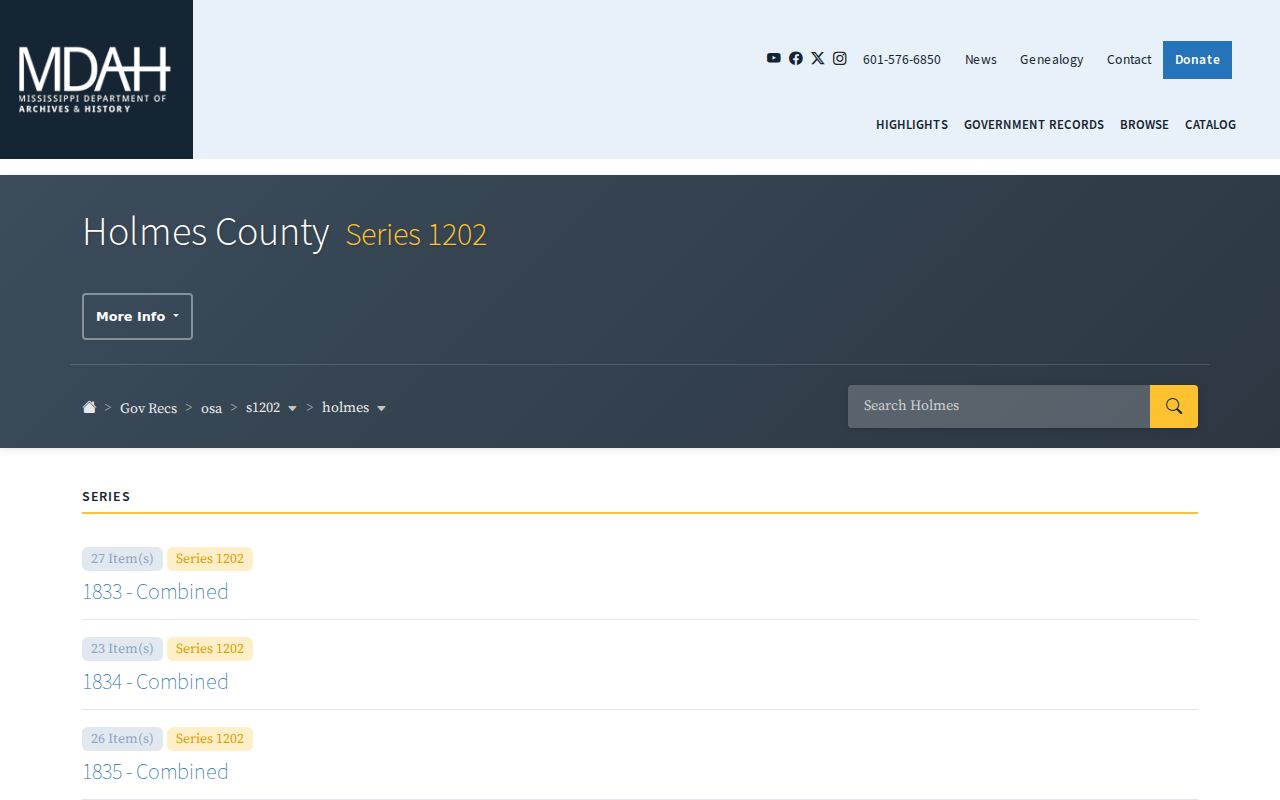
Old Holmes County assessment rolls can hint at who held land and what it was worth. Ownership, though, turns on the deed chain at the Chancery Clerk, never on the roll alone. Holmes County dates to 1833, so its earliest assessments sit near the very start of county government.
Limits of Holmes County Property Tax Records
A tax roll is a limited document. It is not a deed, a survey, an appraisal, or proof of clear title. The name shown is simply the person assessed on January 1. A deed recorded later can outrank it. Likewise, a parcel map places a tax parcel for billing. But only a licensed survey and the recorded documents settle a boundary dispute. The market figure drives taxation. It promises nothing about what a buyer will actually pay. No published Holmes County property tax records search may answer the question. File a specific request with the office. Mississippi's Public Records Act opens nonexempt records to inspection and copying. It favors redaction over blanket withholding and caps fees at actual cost. Name the parcel, the tax year, and the exact fields wanted. A narrow request works far better than asking for all tax records.
Build a Holmes County Tax-Year File
A solid Holmes County property tax file preserves every year as its own snapshot. Capture the parcel number exactly as the office lists it. Add the assessed owner, the situs, the mailing address, and the full legal description. Then log the class, land value, improvement value, and true or market value. Note the assessed value, any exemptions, the millage, the bill amount, and the payment status. The office publishes no parcel-card view. So label each fact by where you got it. Do not point to an online result.
Changes deserve context, not guesses. A new assessed owner may simply reflect a deed. It was recorded after the prior January 1 snapshot. A different parcel number can follow a split, a combination, or a mapping correction. Shifts in assessed value often trace to revaluation or new improvements. A classification change can also shift them. Corrected property facts can shift them too. Wait for the assessor to confirm the cause. When a deed transfer is in play, go to the Chancery Clerk. Compare the recording date and the legal description there. Do not trust the owner field alone.
Keep collection events apart from valuation events. Current payments sit with the Tax Collector. Delinquency, the annual county sale, redemption, and any later state forfeiture are distinct stages. Some involve the Chancery Clerk or the Secretary of State. Ask which stage applied on the date you searched. Keep the receipt, notice, sale reference, or state parcel detail that backs up the answer.
Older research can bridge modern rolls to the MDAH assessment series. The fields differ across eras. Early assessments may group land by district, owner, taxable category, or description rather than street address. Names, neighboring owners, acreage, and deed references serve as the connecting clues. A historical taxpayer entry anchors a dated tax history. It does not prove an unbroken title chain to the present parcel.